Clover
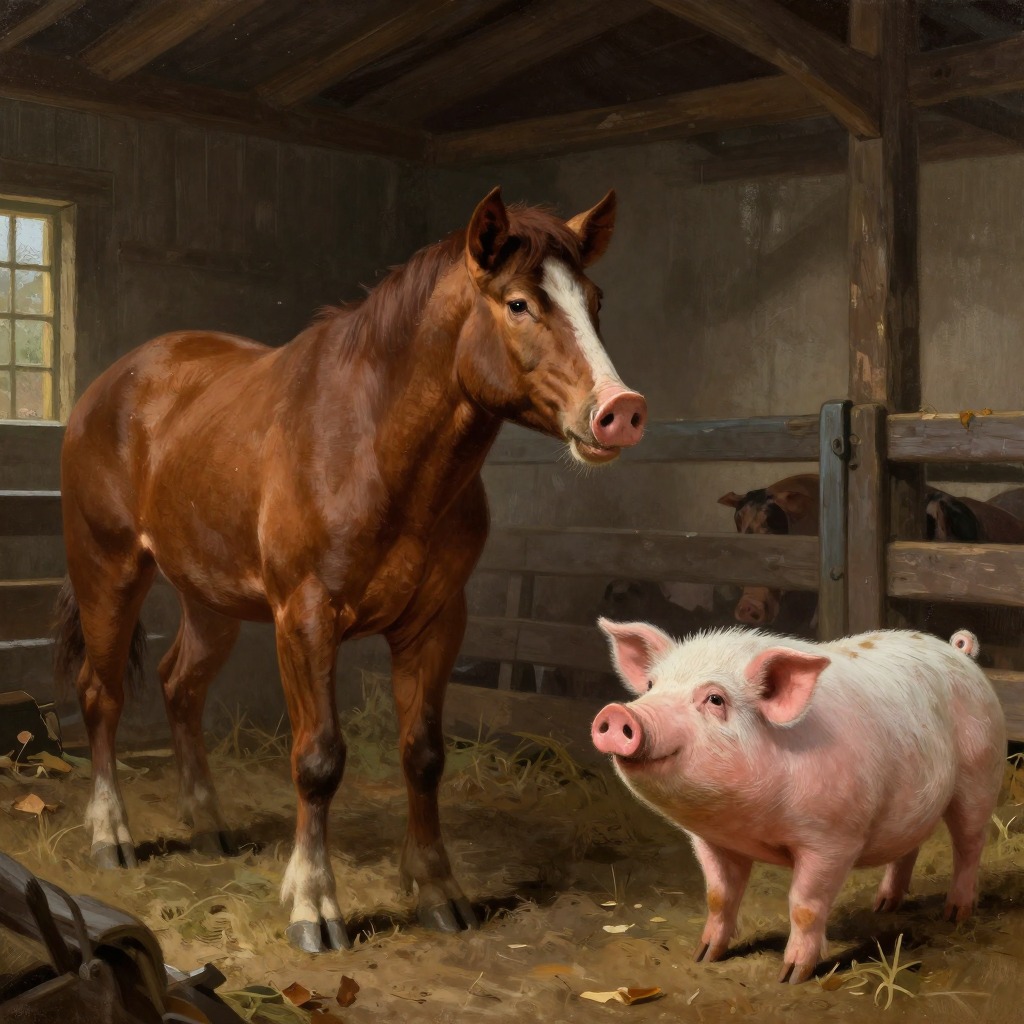
Clover is a stout, motherly mare approaching middle life, who had never quite got her figure back after her fourth foal. She is introduced as one of the two cart-horses, alongside Boxer, and from the very beginning she is distinguished by her protective, nurturing instincts. On the night of Old Major's speech, when a brood of lost ducklings files into the barn, Clover makes a sort of wall round them with her great foreleg, and the ducklings nestle down inside it and promptly fall asleep. This single gesture establishes her as a figure of care and shelter, a role she will maintain even as the farm descends into tyranny. She is not a leader or an intellectual; she learns the whole alphabet but cannot put words together. Yet her emotional memory and her capacity for loyalty and sorrow make her the character through whom the reader most directly feels the tragedy of the Revolution's corruption.
Life and Plot Trajectory
Clover is present at every major turning point of the story, always as a witness and a participant, but never as a decision-maker. She and Boxer are the most faithful disciples of the pigs, absorbing everything they are told and passing it on to the other animals by simple arguments. They are unfailing in their attendance at the secret meetings and lead the singing of 'Beasts of England'. After the Rebellion, she works alongside everyone else, and her strength is part of the collective effort that makes the farm a success. She is the one who discovers Mollie's hidden stash of sugar and ribbons, and she confronts Mollie about her contact with a man from Foxwood. When the pigs move into the farmhouse and begin sleeping in the beds, it is Clover who remembers a definite ruling against beds and fetches Muriel to read the Fourth Commandment. She is the one who, after the executions, looks down the hillside with tears in her eyes, thinking that this was not what they had aimed for when they set themselves years ago to work for the overthrow of the human race. She is the one who, in the final chapter, leads the animals to peer through the farmhouse window and sees the pigs walking on their hind legs, and it is she who asks Benjamin to read the wall, discovering the single altered commandment.
Key Actions and Objectives
Clover's primary objective is never power or personal gain; it is the well-being of the community and the preservation of the original dream. She protects the weak, as she did the ducklings. She warns Boxer not to overstrain himself, telling him that a horse's lungs do not last forever. She treats his split hoof with poultices of herbs which she prepares by chewing them. When Boxer falls, she drops to her knees at his side and cries out to him. When the van comes to take him away, she forces her way to the front, tries to stir her stout limbs to a gallop, and cries his name in a terrible voice, urging him to get out. She is the one who, after the executions, begins to sing 'Beasts of England' as a substitute for the words she lacks, and the other animals take it up, singing it slowly and mournfully. Her actions are always those of a caretaker, a loyal worker, and a keeper of memory.
Relationships and Conflict
Clover's most significant relationship is with Boxer. They come into the barn together, and they spend their Sundays together in the small paddock, grazing side by side and never speaking. She is the one who warns him, who treats his wounds, and who is with him when he falls. After his death, she becomes more isolated, and her old eyes grow dimmer. She also has a quiet, unspoken bond with Benjamin, who, after Boxer's death, becomes more morose and taciturn than ever. Her relationship with the pigs is one of increasing, uncomprehending conflict. She does not rebel, but she questions. She fetches Muriel to read the Commandments, and she is disturbed by the pigs' privileges. Her conflict is internal: she knows that even as things are, they are far better off than in the days of Jones, and that above all else it is needful to prevent the return of the human beings. This belief keeps her faithful, working hard, and accepting the leadership of Napoleon, even as her heart breaks.
Change and Ending
Clover changes from a hopeful, hardworking participant in the Rebellion to a sorrowful, silent witness of its betrayal. In the early days, she gambols in the ecstasy of freedom. By the end, she is an old, stout mare, stiff in the joints and with a tendency to rheumy eyes, two years past the retiring age, though no animal has ever actually retired. Her final act is to lead the animals to the farmhouse window, where they see the pigs and the farmers playing cards. She looks from pig to man and from man to pig, and it is impossible to say which is which. She has no words left; she simply leads the others away. She is the last repository of the original dream, and her silent grief is the story's final verdict.
Thematic Significance
Clover embodies the conscience of the Revolution. She is not clever enough to articulate her doubts, but she feels them. She represents the ordinary, decent animal who works hard, believes in the cause, and is slowly, tragically betrayed. Her inability to read the Commandments for herself symbolizes the dependence of the many on the few for knowledge, a dependence that the pigs exploit. Her persistent loyalty, even in the face of horror, illustrates the power of ideology and the fear of the past. She is the character who most clearly demonstrates that the tragedy of Animal Farm is not just the tyranny of the pigs, but the complicity of the good, the tired, and the hopeful who cannot bring themselves to see the truth until it is too late.